


The largest LEX Developer in Poland voted out!
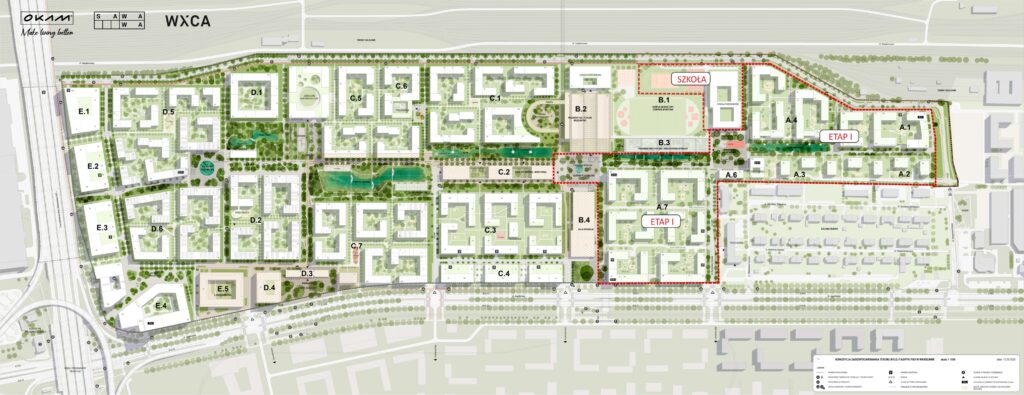
2,050 apartments and a school for 645 students will be built on the former FSO site.
On Thursday, January 15th, during a session of the Warsaw City Council, the final vote was taken regarding the Lex Deweloper procedure for the investment being carried out on the former Passenger Car Factory in Praga-Północ. In addition to the apartments, we will build a new primary school, a section of a park, and road infrastructure on the site. The vote was the final stage of a nearly four-year process that preceded the commencement of the transformation of one of the largest post-industrial plots in the capital.
“We are closing a strategic chapter that required enormous work, coordination, and openness to dialogue with various stakeholders,” commented Anna Watkowska, Project Leader of the F.S.O. PARK Project and Member of the OKAM Management Board, immediately after the vote. “The City Council’s decision is the result of the collaboration of many groups and specialists who have been working together for almost four years on a project that will truly transform this part of Warsaw and become a part of its history,” she added.
The list of people and entities involved in the F.S.O. PARK project is extensive. Primarily, it includes the OKAM team, but also representatives of the architectural studios WXCA – Marta Sękulska-Wrońska and SAWAWA – Piotr Sawicki, responsible for the investment masterplan. Numerous consultants, experts, and representatives of the Warsaw local government, including: Renata Kaznowska, Vice Mayor of Warsaw; Gabriela Szustek, Mayor of Praga Północ; Bartosz Rozbiewski, Acting Director of the Architecture and Spatial Planning Office; Jarosław Węgrzyn, Director of the City Property and State Treasury Office; and Marcin Litwinowicz, Deputy Director of the Education Office, along with their teams.
All supported and collaborated with OKAM in developing the urban, architectural, infrastructural, and social concepts for this complex undertaking.
Key Assumptions of the Lex Developer Procedure
The area covered by the Lex Developer procedure covers an area of 15.6 hectares and is located in Warsaw’s Praga-Północ district – between Jagiellońska Street, the railway line, and the planned Golędzinowska Bis Street. This is the largest project implemented under the Lex Developer provisions in Poland, constituting Phase I of the entire development of the former FSO site.
According to the urban concept developed by WXCA and SAWAWA, Phase I will include the construction of approximately 2,050 apartments in 23 buildings for approximately 4,600 residents, as well as over 60 retail and service premises, along with 6.3 hectares of green space, including a section of the central park measuring over 2 hectares.
The construction of a three-story public school is crucial for city authorities, local residents, and future residents. It will accommodate 645 students. The start of construction will coincide with the commencement of work on the first apartments. OKAM has committed to transferring the entire school building, along with its equipment and associated land, to the city.
Stage I of the F.S.O. PARK project will also include the construction of new road infrastructure, including a section of Golędzinowska Bis Street with sidewalks, a bicycle path, bus stops and pedestrian crossings, and parking spaces.
Transformation of the FSO Site
The F.S.O. PARK project is part of a long-term plan to transform the former Passenger Car Factory (FSO) site, covering a total area of over 62 hectares. Ultimately, a modern, multi-functional district will be created here, with apartments, offices, services, and a central 10-hectare public park, along with recreational areas and open city squares. A total of 20 hectares of green space will be created throughout the property. The new district will house approximately 12,000 apartments, intended for approximately 17,000-19,000 people, as well as numerous new jobs.
F.S.O. PARK includes elements of sustainable water management, including retention reservoirs and a rain garden. The space is designed to limit vehicle traffic, with priority given to residents, pedestrians, and cyclists.
The entire project has been planned in phases and will be implemented over the next 20-25 years.